How PRK (Photorefractive Keratectomy) Improves Vision
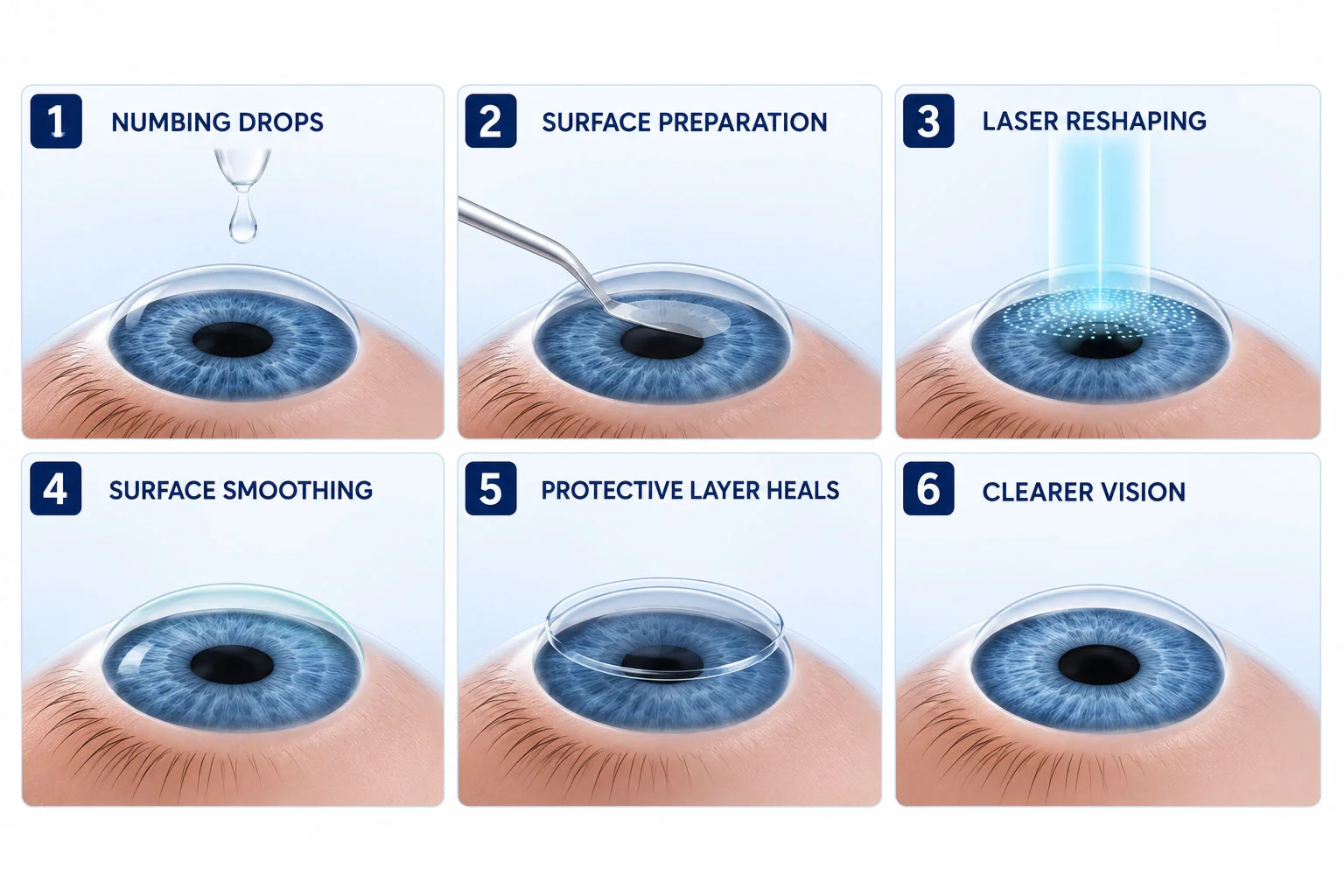
Photorefractive Keratectomy (PRK) improves vision by reshaping the cornea, allowing light to focus accurately on the retina. During the procedure, the thin outer layer of the cornea (epithelium) is gently removed, and an advanced excimer laser precisely reshapes the underlying corneal tissue to correct refractive errors such as myopia, hyperopia, and astigmatism.
Unlike LASIK, PRK does not involve creating a corneal flap, making it an excellent option for patients with thin corneas, dry eyes, or active lifestyles. Although visual recovery may take slightly longer, PRK offers long-lasting vision correction, helping reduce dependence on glasses or contact lenses while providing excellent visual outcomes.
Who Is an Ideal Candidate for PRK?
PRK is an excellent vision correction option for individuals who want to reduce their dependence on glasses or contact lenses. It is particularly recommended for patients who may not be suitable candidates for LASIK due to specific corneal characteristics or lifestyle requirements.
- Thin Corneas: Suitable for patients whose corneas are not ideal for flap-based LASIK surgery.
- Stable Vision: Individuals with a stable glasses or contact lens prescription for at least one year.
- Active Lifestyle: Ideal for athletes, military personnel, and people involved in contact sports or physically demanding professions.
- Healthy Eyes: Candidates should have healthy eyes without active infections, significant corneal disease, or uncontrolled eye conditions.
Medical Suitability for PRK Laser Surgery
Before recommending PRK, your ophthalmologist will perform a detailed eye examination to determine whether the procedure is safe and suitable for you. Ideal candidates generally meet the following criteria:
- Age 18 or Above: With a stable vision prescription for at least one year.
- Healthy Corneas: No significant corneal disease, scarring, or keratoconus.
- Good Overall Eye Health: Free from advanced glaucoma, cataracts, or active eye infections.
- Stable General Health: No uncontrolled diabetes, autoimmune disorders, or conditions that may affect healing.
- Not Pregnant or Breastfeeding: Hormonal changes may temporarily affect vision and healing.
Lifestyle Considerations
PRK may be the preferred choice for individuals with active lifestyles or professions where flap-related complications are a concern.
- Active Professionals: Suitable for athletes, military personnel, police officers, and emergency responders.
- Thin Corneas: An excellent alternative for patients who are not ideal candidates for LASIK.
- Long-Term Vision Correction: Ideal for those seeking lasting freedom from glasses or contact lenses.
How to Prepare for PRK Laser Eye Surgery
A thorough pre-operative evaluation is essential to ensure PRK is the right treatment for your eyes. Your ophthalmologist will assess your vision, corneal thickness, eye health, and medical history to create a personalized treatment plan.
- Stop Wearing Contact Lenses: Discontinue contact lens use as advised before your eye evaluation and surgery.
- Complete Eye Examination: Undergo detailed vision tests, corneal mapping, and other diagnostic scans to confirm your suitability for PRK.
- Review Your Medications: Inform your doctor about all medications and medical conditions, and follow instructions regarding eye drops or other medicines.
- Avoid Makeup & Perfumes: Do not wear eye makeup, lotions, perfumes, or jewelry on the day of surgery.
- Arrange Transportation: Plan for someone to accompany you home, as your vision may be temporarily blurred after the procedure.
When PRK May Not Be the Right Choice
Although PRK is a safe and effective laser vision correction procedure, it may not be suitable for everyone. A comprehensive eye examination helps determine whether PRK is the safest and most appropriate treatment for your vision needs.
Medical Conditions
PRK may not be recommended for individuals with uncontrolled diabetes, autoimmune disorders, delayed wound healing, or those who are pregnant or breastfeeding, as these conditions can affect recovery and visual outcomes.
Eye Conditions
Patients with severe dry eyes, keratoconus, active eye infections, significant corneal scarring, or unstable vision may require alternative treatment options instead of PRK.
Lifestyle Considerations
If your glasses prescription is still changing or your work environment may interfere with proper healing, your ophthalmologist may recommend postponing surgery until your eyes are stable and fully suitable for treatment.
Steps Involved in PRK Laser Eye Surgery
PRK is a quick outpatient laser procedure that reshapes the cornea to correct refractive errors such as myopia, hyperopia, and astigmatism. The surgery is typically completed within 15–30 minutes for both eyes and is performed under topical (eye drop) anesthesia.
- Numbing the Eye: Anesthetic eye drops are applied to ensure a comfortable and pain-free procedure, while a lid holder keeps the eye gently open.
- Removing the Corneal Epithelium: The thin outer layer of the cornea (epithelium) is carefully removed to expose the underlying corneal tissue.
- Laser Vision Correction: An advanced excimer laser precisely reshapes the cornea to correct the refractive error and improve the way light focuses on the retina.
- Bandage Contact Lens: A soft protective contact lens is placed over the cornea to promote healing and reduce discomfort during recovery.
- Post-Operative Care: Antibiotic and anti-inflammatory eye drops are prescribed to prevent infection and support proper healing.
- Follow-up & Recovery: The protective contact lens is usually removed after 3–5 days, with vision gradually improving over the following weeks as the cornea heals.
PRK vs Femto LASIK vs Contoura Vision
Each laser vision correction procedure offers unique advantages depending on your eye condition, corneal thickness, lifestyle, and visual requirements. Your ophthalmologist will recommend the most suitable treatment after a comprehensive eye examination.
| Feature |
PRK |
Femto LASIK |
Contoura Vision |
| Procedure |
Surface laser treatment without creating a corneal flap. |
Laser-created corneal flap followed by vision correction. |
Topography-guided customized laser vision correction. |
| Technology |
Excimer Laser |
Femtosecond + Excimer Laser |
Topography-Guided Excimer Laser |
| Corneal Flap |
No flap created. |
Creates a corneal flap. |
Creates a customized corneal flap. |
| Best For |
Thin corneas and active lifestyles. |
Most patients with adequate corneal thickness. |
Patients seeking highly customized vision correction. |
| Recovery Time |
3–7 days for initial healing. |
24–48 hours. |
24–48 hours. |
| Comfort |
Mild discomfort during healing. |
Minimal discomfort. |
Minimal discomfort. |
| Vision Results |
Excellent long-term outcomes. |
Fast visual recovery with excellent clarity. |
Highly personalized, sharp vision. |
| Suitability |
Ideal for patients unsuitable for LASIK. |
Suitable for most refractive errors. |
Best for eligible patients requiring customized treatment. |
Benefits of PRK (Photorefractive Keratectomy)
PRK is a proven laser vision correction procedure that offers long-lasting visual improvement without creating a corneal flap. It is an excellent option for eligible patients seeking greater freedom from glasses or contact lenses.
- Flap-Free Procedure: PRK reshapes the cornea without creating a flap, eliminating flap-related complications.
- Ideal for Thin Corneas: A preferred option for patients who may not be suitable candidates for LASIK due to reduced corneal thickness.
- Long-Term Vision Correction: Provides stable, lasting visual outcomes with reduced dependence on corrective eyewear.
- Suitable for Active Lifestyles: Recommended for athletes, military personnel, and individuals involved in contact sports or physically demanding professions.
- Lower Risk of Dry Eye: Preserves more corneal nerves, which may reduce the likelihood of post-operative dry eye symptoms.
- High Success Rate: Delivers excellent visual outcomes when performed on appropriately selected patients and combined with proper post-operative care.
Risks & Possible Complications of PRK Laser Eye Surgery
PRK is a safe and well-established laser vision correction procedure with a high success rate. However, like any surgical treatment, it carries certain risks and temporary side effects. Your ophthalmologist will discuss these before the procedure and guide you throughout your recovery.
- Temporary Discomfort: Mild pain, irritation, tearing, and light sensitivity are common during the first few days after surgery.
- Dry Eyes: Some patients may experience temporary dryness, which is usually managed with lubricating eye drops.
- Corneal Haze: Mild corneal haze may develop during healing but generally improves over time with appropriate treatment.
- Glare & Halos: Temporary glare, halos, or reduced night vision may occur during the healing period.
- Residual Refractive Error: In some cases, minor undercorrection or overcorrection may require enhancement after complete healing.
- Infection: Although rare, infection can occur if post-operative care instructions are not followed carefully.