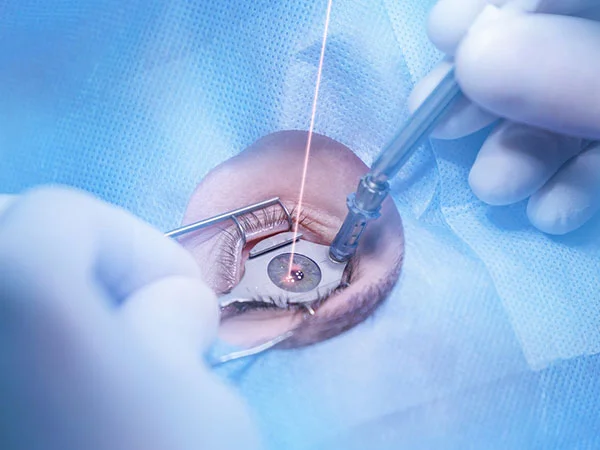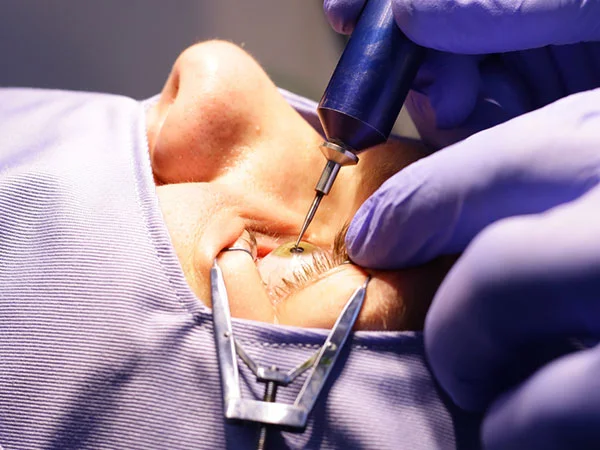

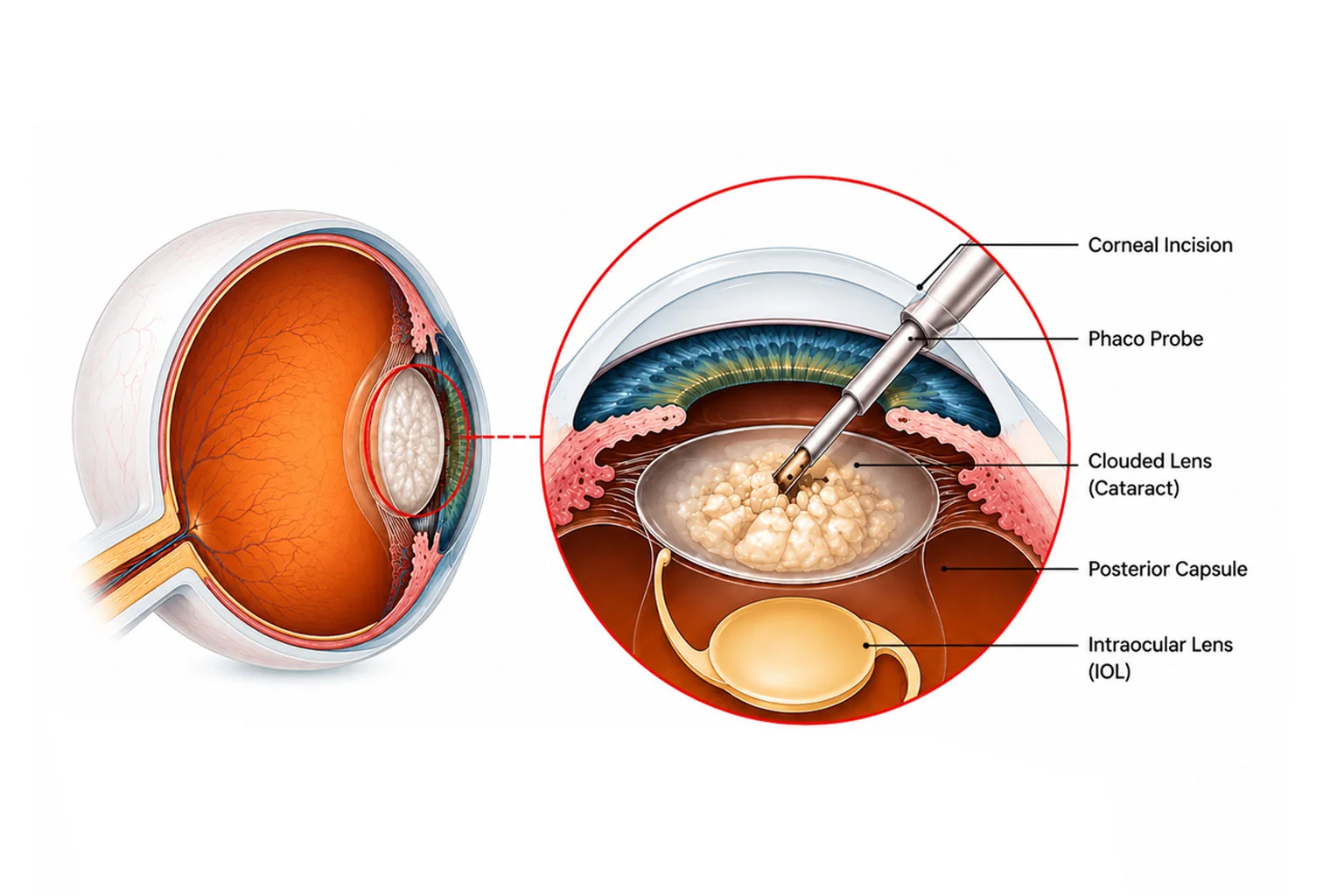
Phaco Surgery, also known as phacoemulsification, is the most advanced and widely performed procedure for treating cataracts. During the surgery, ultrasound energy is used to gently break the cloudy natural lens into tiny fragments, which are removed through a small self-sealing incision. A premium Intraocular Lens (IOL) is then implanted to restore clear, sharp vision.
Compared with traditional cataract surgery, Phaco Surgery is minimally invasive, requires no stitches in most cases, and offers faster healing, minimal discomfort, and excellent visual outcomes. The procedure is typically completed within 15–30 minutes under local anesthesia, allowing most patients to return home the same day and resume normal activities within a short period.
| Feature | Details |
|---|---|
| Incision Size | 2–3 mm micro-incision that usually heals without stitches |
| Anesthesia | Performed comfortably under topical or local anesthesia |
| Procedure Time | Approximately 15–30 minutes per eye |
| Hospital Stay | Day-care procedure with same-day discharge |
| Lens Implant | Premium foldable Intraocular Lens (IOL) implanted |
| Recovery | Most patients notice clearer vision within 24–48 hours |
| Success Rate | Highly successful with excellent long-term visual outcomes |
Phaco Surgery is a precise, minimally invasive cataract procedure performed using advanced ultrasound technology. The cloudy natural lens is gently broken into tiny fragments and removed through a small self-sealing incision before being replaced with a premium intraocular lens (IOL). The surgery is typically completed in 15–30 minutes under local anesthesia and requires no stitches in most cases.
Step 1: Eye Preparation
Numbing eye drops are administered to ensure a comfortable, pain-free procedure. The pupil is dilated using special eye drops, and the eye is cleaned under sterile conditions.
Step 2: Micro-Incision
A tiny 2–3 mm self-sealing incision is created at the edge of the cornea, allowing the surgeon to access the cataract without requiring stitches.
Step 3: Opening the Lens Capsule
A small circular opening is carefully created in the front portion of the natural lens capsule to expose the cataract while preserving the capsule for the new lens.
Step 4: Cataract Removal
An ultrasonic Phaco probe breaks the cloudy lens into microscopic fragments using high-frequency vibrations. These fragments are simultaneously suctioned out, leaving the capsule intact.
Step 5: Intraocular Lens (IOL) Implantation
A foldable artificial intraocular lens is inserted through the same micro-incision. Once inside the eye, it unfolds naturally and is positioned securely within the lens capsule.
Step 6: Completion & Recovery
The incision seals naturally without stitches in most cases. Protective eye drops are applied, and after a short observation period, patients can return home the same day.
Phaco Surgery is the preferred technique for modern cataract treatment because it combines advanced technology with excellent visual outcomes. Its minimally invasive approach allows patients to experience faster healing, greater comfort, and long-lasting vision improvement compared to conventional cataract surgery.
Micro-Incision Surgery
A tiny 2–3 mm self-sealing incision minimizes trauma to the eye, promotes faster healing, and significantly reduces the risk of infection or bleeding.
Stitch-Free Procedure
The small incision naturally seals in most cases, eliminating the need for stitches and making recovery more comfortable.
Faster Visual Recovery
Most patients notice improved vision within 24–48 hours and can return to their normal daily routine shortly after surgery.
Minimal Discomfort
Performed under topical or local anesthesia, the procedure is virtually painless and causes very little postoperative discomfort.
High Precision & Safety
Advanced ultrasound technology enables precise cataract removal while preserving healthy eye tissues, resulting in safer surgery and predictable outcomes.
Sharper Vision with Premium IOLs
Premium intraocular lenses (IOLs) provide clearer, brighter vision and may reduce dependence on glasses after surgery.
Day-Care Procedure
Phaco Surgery is completed on an outpatient basis, allowing patients to return home the same day without prolonged hospitalization.
| Benefit | Advantage |
|---|---|
| Micro-Incision | Smaller wound, faster healing, and lower infection risk |
| Stitch-Free Surgery | Natural wound sealing with minimal postoperative discomfort |
| Quick Recovery | Most patients regain functional vision within 1–2 days |
| Premium IOL | Restores sharp, clear vision with excellent long-term outcomes |
| High Safety | Advanced technology ensures precise and predictable treatment |
| Day-Care Procedure | Same-day discharge with no prolonged hospital stay |
Phaco Surgery is recommended for individuals whose cataracts significantly affect their vision and daily activities. Before surgery, a comprehensive eye examination is performed to evaluate cataract severity, overall eye health, and suitability for intraocular lens (IOL) implantation.
A detailed pre-operative assessment—including slit-lamp examination, ocular biometry, corneal measurements, retinal evaluation, and IOL power calculation—helps ensure the safest procedure and the best possible visual outcome.
Phaco Surgery is a safe and highly successful cataract treatment for most patients. However, certain eye conditions may require additional evaluation, specialized surgical techniques, or an alternative approach to ensure the safest and most effective outcome.
| Condition | Why It Requires Special Attention |
|---|---|
| Severe Corneal Disease | Reduced corneal health may increase the risk of delayed healing or corneal damage during surgery. |
| Weak Lens Support | Weak or damaged lens-supporting fibers may require additional surgical devices or techniques. |
| Active Eye Infection | Surgery is postponed until the infection or inflammation is completely treated. |
| Advanced Uveitis | Chronic inflammation increases the risk of postoperative complications and requires careful management. |
| Very Dense Cataracts | Advanced cataracts may require greater ultrasound energy or an alternative cataract surgery technique. |
| Uncontrolled Glaucoma | Eye pressure should be stabilized before cataract surgery for optimal safety. |
| Retinal Disorders | Conditions such as retinal detachment or advanced macular disease may need treatment before or along with cataract surgery. |
Every patient at Retiora Eye Care undergoes a comprehensive eye examination, including corneal evaluation, retinal assessment, and biometric measurements, to determine the safest surgical approach and deliver the best possible visual outcome.
Phaco Surgery is one of the safest and most successful cataract procedures available today. While serious complications are uncommon, every surgical procedure carries some degree of risk. Careful pre-operative evaluation, advanced surgical techniques, and regular follow-up care significantly reduce the likelihood of complications.
| Complication | Severity | Description |
|---|---|---|
| Corneal Swelling | Low | Temporary blurred vision that generally improves within a few days. |
| Inflammation | Low | Mild redness or irritation controlled with prescribed eye drops. |
| Raised Eye Pressure | Moderate | Usually temporary and managed effectively with medication. |
| Posterior Capsule Opacification | Moderate | Clouding behind the implanted lens that can be corrected with a YAG laser. |
| Cystoid Macular Edema | Rare | Retinal swelling that may temporarily reduce vision and requires treatment. |
| Infection | Very Rare | Requires immediate treatment to protect vision and prevent complications. |
Most complications are uncommon and can be successfully managed when detected early. Attending scheduled follow-up visits and using prescribed medications as directed are essential for achieving the best visual outcome after Phaco Surgery.
Both Phaco Surgery and traditional cataract surgery are effective treatments for removing cataracts and restoring vision. However, modern Phaco Surgery (Phacoemulsification) has become the preferred approach due to its smaller incision, quicker recovery, reduced discomfort, and improved surgical precision.
| Feature | Phaco Surgery | Traditional Cataract Surgery |
|---|---|---|
| Incision Size | 2–3 mm micro-incision | 10–12 mm larger incision |
| Need for Stitches | Usually not required | Often required |
| Anesthesia | Topical or local anesthesia | Local anesthesia with sedation |
| Procedure Time | 15–30 minutes | 30–60 minutes |
| Recovery | Most patients recover within 1–2 days | Recovery may take 1–2 weeks |
| Hospital Stay | Day-care procedure | May require overnight observation |
| Risk of Complications | Lower due to minimally invasive technique | Relatively higher because of larger incision |
| Visual Recovery | Faster and more predictable | Gradual recovery over several weeks |
For most patients, Phaco Surgery offers a safer, more comfortable, and faster path to clearer vision. During your consultation at Retiora Eye Care, our cataract specialists will recommend the most appropriate surgical technique based on your eye health, cataract severity, and visual needs.
Recovery after Phaco Surgery is usually quick because of the small, self-sealing incision used during the procedure. Most patients notice improved vision within the first 24–48 hours, while complete healing typically occurs over the following few weeks. Following your ophthalmologist’s instructions and attending scheduled follow-up visits are essential for achieving the best visual outcome.
| Recovery Period | What to Expect |
|---|---|
| First 24 Hours | Mild irritation, blurred vision, light sensitivity, and use of a protective eye shield. |
| 2–7 Days | Vision becomes clearer, discomfort decreases, and most routine activities can be resumed. |
| 2–4 Weeks | Eye continues to heal, vision stabilizes, and follow-up examinations confirm recovery. |
| 4–6 Weeks | Complete healing for most patients with optimal long-term visual results. |
Proper post-operative care is essential for a smooth recovery and optimal visual outcomes after Phaco Surgery. Following your ophthalmologist’s instructions helps reduce the risk of infection, inflammation, and other postoperative complications while promoting faster healing.
While most patients recover smoothly after Phaco Surgery, certain symptoms require immediate medical attention. Early treatment can prevent serious complications and help preserve vision.
One of the major advantages of modern Phaco Surgery is the ability to customize vision correction by selecting an intraocular lens (IOL) that matches the patient’s lifestyle, visual needs, and eye condition.
| IOL Type | Best For | Key Benefits |
|---|---|---|
| Monofocal IOL | Distance or near vision correction | Excellent clarity with reliable visual outcomes. |
| Multifocal IOL | Near, intermediate & distance vision | Reduces dependence on spectacles for most activities. |
| Toric IOL | Cataract with astigmatism | Corrects astigmatism while restoring clear vision. |
| EDOF IOL | Patients seeking continuous range of vision | Provides extended focus with fewer visual disturbances. |
Your ophthalmologist will recommend the most suitable lens after evaluating your eye health, lifestyle, visual expectations, and budget.
Modern Phaco Surgery combines advanced surgical technology with precision techniques to deliver safer cataract removal, faster healing, and excellent visual outcomes. At Retiora Eye Care, state-of-the-art diagnostic and surgical systems help improve accuracy while enhancing patient comfort.
These innovations allow cataract surgery to be performed through tiny incisions with greater precision, minimal discomfort, and faster visual recovery than conventional techniques.
The success of Phaco Surgery depends not only on advanced technology but also on detailed pre-operative evaluation, experienced ophthalmologists, and personalized post-operative care. At Retiora Eye Care, every treatment plan is tailored to achieve the best possible visual outcome for each patient.